
Voices from the Two Sessions: The Proposal of Lin Jing, Representative of Haidian District and Chairman and CEO of Jiaxun Feihong, Focuses on Deepening the Foundation of Good Law and Good Governance
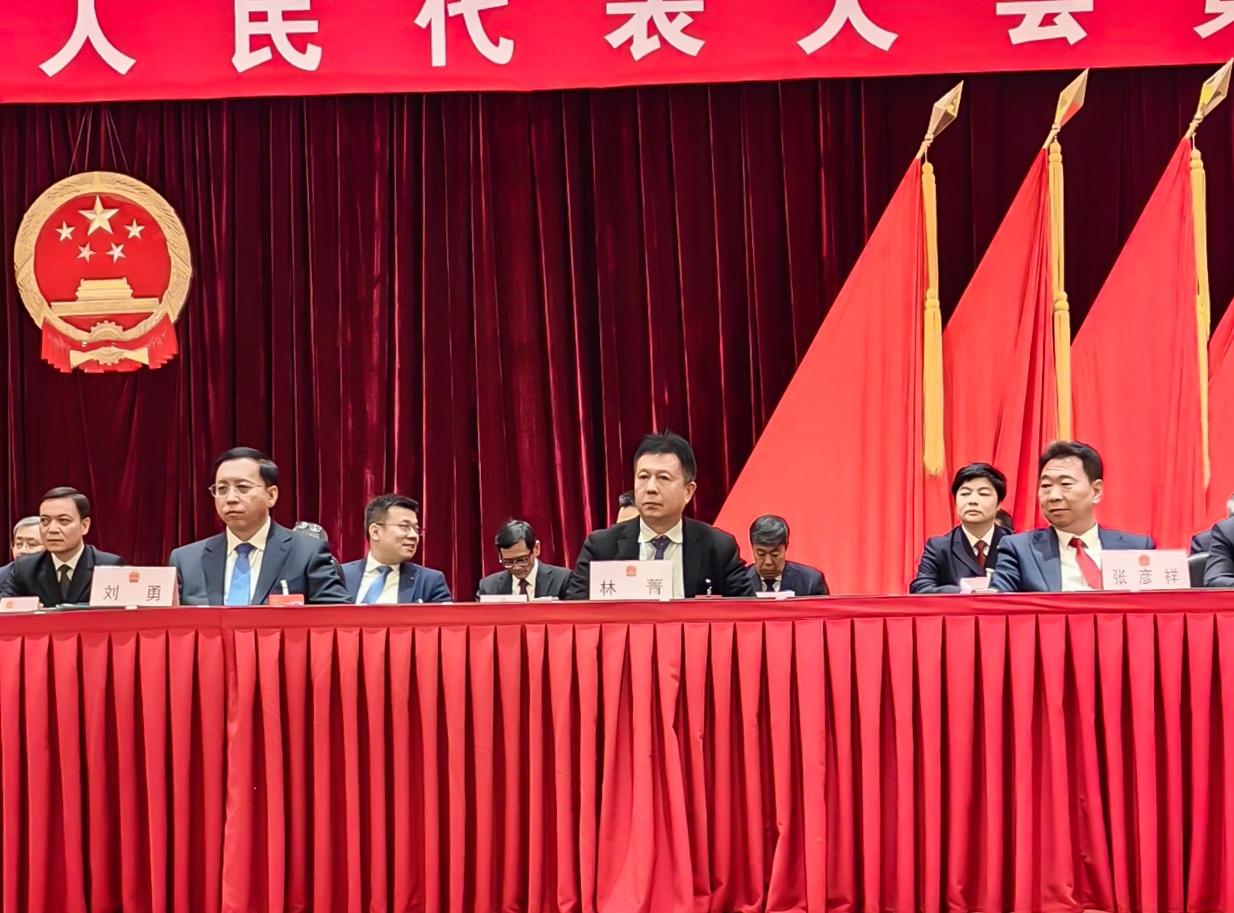
On January 7th, the 5th Session of the 17th People's Congress of Haidian District, Beijing, grandly opened amidst the resounding national anthem. The atmosphere in the venue was solemn and enthusiastic, filled with a spirit of unity and progress. Delegates from all walks of life and various sectors in Haidian District, bearing the expectations and entrustment of the people of the district, upheld the organic unity of the leadership of the Party, the people's role as masters of the country, and the rule of law. They deeply practiced whole-process people's democracy, exercised their powers effectively in accordance with the law, and contributed to the development of new types of productive forces, the construction of a world-leading science and technology park, and the vigorous writing of a new chapter in building a modern and high-quality Haidian District. As a member of the Standing Committee of the Haidian District People's Congress in this session, and the Chairman and CEO of Beijing Jiaxun Feihong Electrical Co., Ltd. (hereinafter referred to as "Jiaxun Feihong," stock code: 300213), Lin Jing has brought forward a proposal titled "Suggestions on Further Deepening the Foundation of Good Law and Good Governance to Ensure the High-Quality Development of Haidian's Economy." This proposal focuses on regional rule of law construction and high-quality economic development, offering valuable advice and suggestions. It is of great significance for creating a first-class business environment that is market-oriented, rule-of-law-based, and internationalized. Preface to the Proposal: President Xi Jinping has profoundly pointed out that the rule of law is the best business environment. Both the 20th National Congress of the Communist Party of China and the Third Plenary Session of the 20th Central Committee have made deployments for "creating a first-class business environment that is market-oriented, rule-of-law-based, and internationalized," issuing a call to action for creating a first-class business environment from a new historical starting point. As the "stabilizer" of the capital's economy, Haidian District, under the strong leadership and guidance of the district committee, has seen its "two courts" and public security departments perform their duties in accordance with the law and enforce the law in a civilized manner. All functional departments have worked together and exerted joint efforts, actively responding to market demands for the rule of law, improving the legal system, and innovating law enforcement concepts. As a result, Haidian has become one of the first national demonstration zones for the construction of a rule-of-law government. Its business environment has consistently ranked at the top, forming a strong legal advantage. However, it also faces new challenges in legal issues brought about by a new round of scientific and technological innovation and competition. Representative Lin Jing pointed out that as a region with the densest concentration of scientific and technological innovation and the most vibrant economic activities, Haidian District has in recent years set an important goal of enhancing its innovation capacity and building the core area of an international center for scientific and technological innovation. It has higher requirements for creating a harmonious and stable business environment and attracting international talents for innovation and entrepreneurship. Therefore, in creating a new situation of good law and good governance, it shoulders the important task of being a pioneer and a pilot: Firstly, the rapid development of emerging industries continues to give rise to new economic forms and models, which bring a series of legal issues. There are gaps or slow updates in the relevant laws and regulations in key areas, emerging fields, and foreign-related fields, and the connection between regulations lags behind, resulting in uncertainties in the operations of some enterprises. Secondly, there is a certain degree of fragmentation in law enforcement coordination. When dealing with cross-field and cross-regional economic cases, there are problems such as poor information sharing and low cooperation efficiency. When some innovative businesses involve multi-department supervision, there are law enforcement conflicts, which increase the compliance costs for enterprises and affect fairness and authority. Thirdly, legal professionals are mainly concentrated in large law firms and the legal departments of a few large enterprises. Small and medium-sized enterprises lack sufficient legal strength and have difficulty obtaining professional, precise, and cost-appropriate legal services. Against the backdrop of intensified competition between China and foreign countries, the increase in foreign-related legal issues and the relative insufficiency of legal services have magnified the legal risks of enterprises' independent operations. To address these issues, Representative Lin Jing has put forward countermeasures and suggestions. In the face of new trends in scientific and technological development, new forms of industrial transformation, new patterns of international competition, and new expectations of market entities, Haidian District needs to fully leverage its legal advantages, promote a new round of pilot reforms in the field of law, deepen the foundation of good law and good governance, shape a higher-level new advantage of an open economy, and provide legal support for the high-quality development of the regional economy. Haidian’s economy is characterized by technology leadership, and the legislative tasks in emerging fields are substantial. It is suggested that a special working group for legal construction in emerging fields be established, led by the district government or the People’s Congress, and comprising public security, procuratorial, judicial, and regulatory departments, as well as experts from universities, research institutions, industry associations, and business representatives. This group should monitor technological trends, assess legal needs, and promptly introduce or amend special regulations in relevant fields to clarify the rules for industrial development and the boundaries of rights and interests. Focus on the application scenarios of new technologies such as big data, blockchain, algorithmic recommendation, deep synthesis, and AIGC. Strengthen regulatory research and legislative work for new forms and models of business. For example, clarify liability determination for autonomous vehicles, safety supervision, taxation, and liability attribution in the sharing economy, ethical issues of machine decision-making and data bias in the AI industry, data privacy protection for big data and cloud computing companies and social media platforms, and intellectual property protection for tool software, business methods, and cultural creativity. Following the principle of balancing regulatory norms with promoting development, establish a dynamic updating mechanism for industry regulations to set an example nationwide. Under the current economic downward pressure, many enterprises are facing operational difficulties, and local governments are under financial strain. Enforcement actions that infringe upon the rights and interests of private enterprises have increased. It is urgent to stabilize market expectations and boost venture investment confidence as part of improving law enforcement. It is suggested that a joint law enforcement command center be formed by public security, procuratorial, judicial, and other departments to carry out special law enforcement actions related to enterprises. Integrate data from multiple departments such as industry and commerce, taxation, and intellectual property rights. Systematically review enforcement practices that contradict an internationalized, rule-of-law-based, and market-oriented business environment, such as non-compliant, profit-driven, selective, and frequent or mechanical enforcement. Standardize law enforcement practices and improve enforcement efficiency. Strengthen supervision over administrative law enforcement departments and guide public security, procuratorial, judicial, and other public power departments to strictly adhere to their authority boundaries, standardize law enforcement behavior, and eliminate abnormal increases in fines and confiscations and "oceanic fishing" practices. Publicize electronic mailboxes for complaints about administrative law enforcement, enhance supervision over law enforcement in enterprise reporting and case filing, application of coercive measures, cooperation in异地办案 (cross-regional case handling), and seizure, detention, and freezing, and improve the verification and supervision mechanism to promptly respond to reports. Protect enterprise property rights and the rights and interests of entrepreneurs in accordance with the law, and resolve disputes arising from enterprise mergers and reorganizations, business integration, and relocation in a timely manner. Provide legal protection for domestic and foreign investors to invest and start businesses. As an important core asset for private enterprises, intellectual property rights (IPR) play an increasingly important role in reflecting enterprise value and maintaining competitive advantages. Among the top 100 private enterprises in Beijing in 2023, more than 50 had a research and development intensity exceeding 20%, with both the proportion and authorization volume of invention patents reaching new highs. The average annual growth rate of patent cases over the past decade reached 5.24%. However, the insufficient legal affairs strength and weak protection measures of small and medium-sized private enterprises are relatively prominent. Difficulties in detecting infringement, filing cases, and obtaining evidence, as well as long维权周期 (rights protection cycles), have become major challenges. In addition, high lawyer fees and litigation costs bring risks. Some enterprises either take the risk or ignore the issue, which encourages certain illegal activities. To address this, Representative Lin Jing suggests strengthening the judicial concept that "protecting intellectual property rights is protecting enterprise innovation." Organize judicial departments and bar associations to conduct in-depth research and analysis of infringement behaviors, increase training on common IPR-related legal issues, establish a special fund to support the legal affairs of small and medium-sized enterprises, and encourage law firms to cooperate with universities to carry out targeted training programs for legal professionals. Optimize the supply of legal services and boost private enterprises' confidence in innovation and investment. Pay close attention to the cross-enterprise mobility of scientific and technological talents and innovation teams, especially the leakage of business secrets, sensitive information, and IPR caused by high-salary recruitment by large enterprises, and the resulting IPR disputes. Fully consider the weak risk resistance capacity of small and medium-sized private enterprises, and promote the establishment of a regular communication and coordination mechanism among courts, procuratorates, public security organs, and judicial departments. Establish a diversified IPR dispute resolution platform, prioritize non-litigation dispute resolution mechanisms, help enterprises involved in disputes analyze the focus of the dispute, formulate the best solution, and strive to reach a settlement agreement on the basis of equality and voluntariness to reduce the legal barriers for private enterprises. At the same time, promote the establishment of a non-litigation connection mechanism and improve the "green channel" for fast trial, fast conclusion, and fast execution from case filing to execution to reduce the burden on enterprises and create a better legal environment for the rights protection of small and medium-sized enterprises. Haidian District is home to a large number of high-tech enterprises, well-known leading enterprises, headquarters enterprises, and emerging venture capital enterprises. These enterprises are prone to becoming the focus of public opinion. In recent years, some negative public opinion events involving well-known enterprises have caused damage to their brand reputation and disrupted their normal development. It is suggested that the government strengthen the construction of an all-media communication system, set up legal columns to enhance the dissemination of legal public opinion in the economic field, and promote the establishment of a spokesperson system for judicial organs to release authoritative information in a timely manner on major legal events and hot cases in the economic field. Cultivate legal opinion leaders, including legal experts, scholars, and experienced legal workers, to provide detailed interpretations of relevant cases and the application of laws, guide the public to discuss legal topics rationally, and correct wrong legal concepts in a timely manner. Law enforcement departments such as public security, procuratorial, judicial, and other authorities should promptly and legally punish extreme remarks that intentionally mislead the public and attract attention, as well as infringing behaviors that attack and defame enterprises and entrepreneurs, to prevent negative public opinion from fermenting and causing harm to enterprises and entrepreneurs, and effectively protect the legal rights and interests of enterprises and entrepreneurs. Strengthen legal aid and judicial protection for scientific and technological talents, especially those who fail in innovation and entrepreneurship. Timely stop illegal acts that infringe upon personality rights, so that they can receive care and support when suffering from unfair treatment, and promote the formation of a good legal public opinion environment that respects science and technology, embraces innovation, and tolerates failure. As a private entrepreneur who has been rooted in Haidian's fertile ground for scientific and technological innovation and entrepreneurship for thirty years, Representative Lin Jing has long paid special attention to the new problems and challenges faced by private enterprises in Beijing during their development. He is committed to fully exercising his duties as a representative of the People’s Congress. He has put forward many excellent suggestions on improving educational resources in the northern area of Haidian Science City and attracting high-quality talents, which have been highly valued by the district government and have achieved very significant results.
I. Accelerate Legislation in Emerging Fields and Improve the Legal System to Meet Haidian’s Economic Development Needs
II. Strengthen Coordination Among Law Enforcement Departments to Create a Stable and Predictable Law Enforcement Environment for Venture Investment
III. Emphasize Intellectual Property Protection and Establish an Efficient Response Mechanism for Intellectual Property Protection
IV. Strengthen Social Public Opinion Governance to Create a Positive and Innovative Legal Public Opinion Environment

-
Jiaxun Feihong Attends HUAWEI CONNECT 2026: Multi-Modal Sensing Empowers Railway Perimeter Security
2026-09-20 -
Jiaxun Feihong Welcomes KAI, SURGE and Huawei Delegation to Explore Digital Upgrading of Indonesia's Railway Communications
2026-09-10 -
Jiaxun Intelligent Navigation VCS8800 Voice Communication Switching System Receives CAAC Use License
2026-08-28 -
A Delegation from PRASA and MACRE JV Visits Jiaxun Feihong for Exchange on South Africa’s Railway Communications Upgrade
2026-07-10 -
China Eastern Airlines' First Self-Developed Communication Dispatch System Goes into Operation
2026-06-18 -
JiaXun Feihong Joins Huawei at China Local Railway Innovation Forum, Showcasing AI-Powered Safety Solutions
2026-04-21 -
Voices from the Two Sessions: The Proposal of Lin Jing, Representative of Haidian District and Chairman and CEO of Jiaxun Feihong, Focuses on Deepening the Foundation of Good Law and Good Governance
2025-01-10 -
Nigerian Railway Delegation Visits Jiaxun Feihong for Factory Acceptance of Kaduna–Kano Railway Equipment
