
Multi-Dimensional Shield: Jiaxun Feihong Guarding the Railway's Steel Arteries
Since the beginning of this summer, regions including Guangdong, Fujian, Henan, Shaanxi, and the Beijing-Tianjin-Hebei area have successively experienced extreme weather events such as torrential rains, mountain floods, and urban waterlogging……
Since the beginning of this summer, regions including Guangdong, Fujian, Henan, Shaanxi, and the Beijing-Tianjin-Hebei area have successively experienced extreme weather events such as torrential rains, mountain floods, and urban waterlogging. The resulting emergencies—including road damage, base station outages, and railway line suspensions—have posed severe challenges to national emergency response and disaster relief command. Against the backdrop of global climate anomalies and the frequent occurrence of extreme weather, these events further underscore the critical importance of reliable emergency communication support.

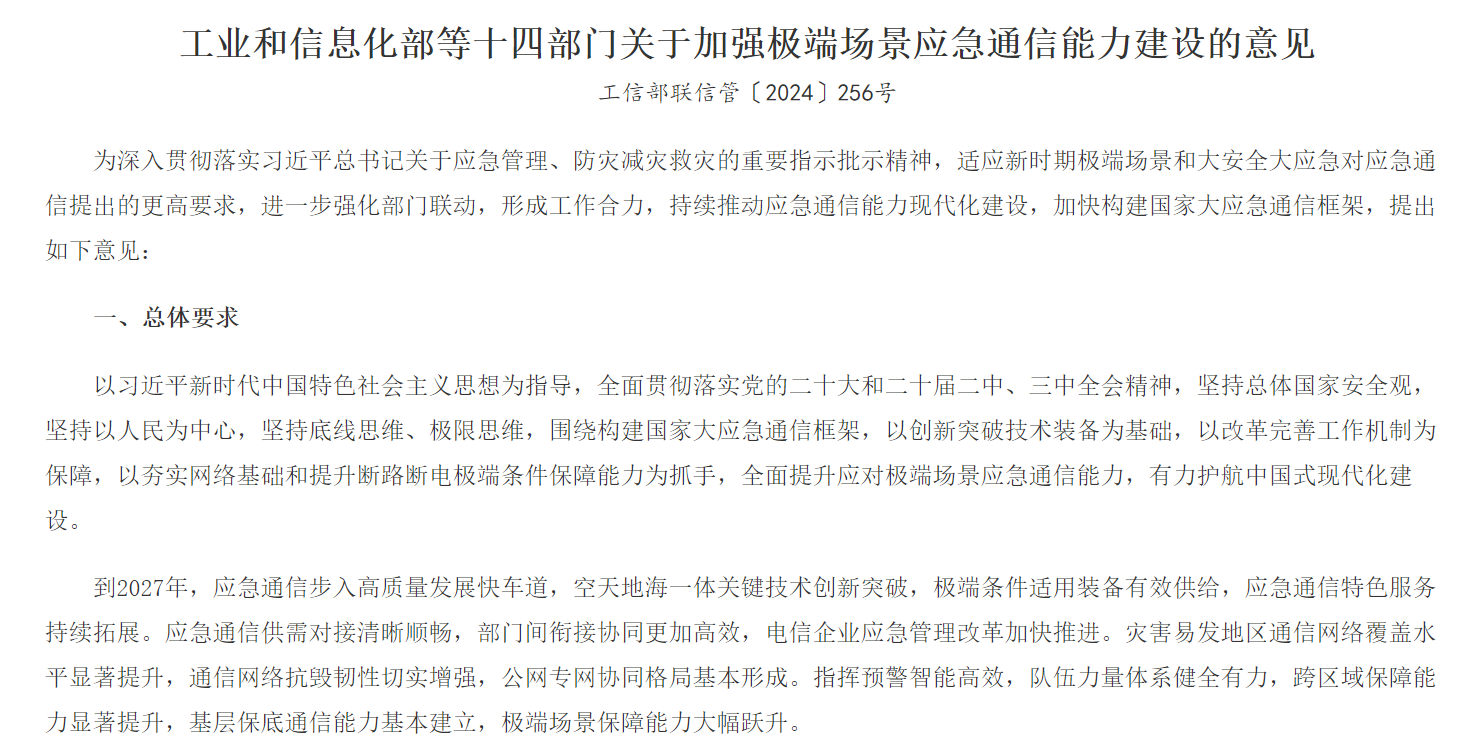
To thoroughly implement General Secretary Xi Jinping’s important instructions and directives on emergency management, disaster prevention, mitigation, and relief, and to meet the heightened requirements for emergency communications under extreme scenarios within the integrated framework of “comprehensive security and all-hazards emergency management,” the Ministry of Industry and Information Technology, together with thirteen other ministries and departments, issued the Guiding Opinions on Strengthening Emergency Communication Capabilities in Extreme Scenarios at the end of 2024.
The document emphasizes that, at the technological level, key technologies—including drone-based communications and satellite-terrestrial integrated networks—should be advanced through the “List-and-Challenge” (Jiebang Guashuai) mechanism. At the equipment level, it mandates the development of lightweight, portable systems (e.g., backpack-mounted base stations) and weather-resistant devices operable across a temperature range of –30°C to 70°C, specifically tailored for deployment in grassroots environments such as mountainous regions and dense forests. By 2027, the initiative aims to significantly enhance network coverage in disaster-prone areas and ensure 100% availability of baseline emergency communication capabilities at the grassroots level.
Driven by both policy and technological innovation, China's emergency communication industry policy system is evolving toward an integrated, intelligent air-space-ground-sea framework. A multi-tiered support structure has been established, providing systematic backing focused on four key areas: technological breakthroughs, equipment development, grassroots-level coverage, and ecosystem collaboration.
Within the critical national infrastructure of railway transport, the railway emergency communication system serves as a vital component of the railway emergency management system. During incidents, it is responsible for transmitting firsthand information promptly, accurately, and reliably, providing a basis for commanders to quickly assess situations and make informed decisions. When traditional networks fail during floods, emergency communication becomes the "nerve center" of disaster relief. With its anti-interference design and rapid deployment capability, it establishes an uninterrupted information bridge at disaster sites, strengthening the safety line for railway operations. In these critical moments, communication is truly a lifeline.

In response, Beijing Jiaxun Feihong Electric Co., Ltd. (hereinafter "Jiaxun Feihong", stock code: 300213) has independently developed an emergency communication system designed for public-private network integration. Built on an IMS-based converged dispatch communication platform, it incorporates ICT technologies such as GIS, BeiDou spatio-temporal positioning, and emergency big data. The system and its equipment are designed for flexible deployment, supporting rapid access via 4G/5G public networks, high-throughput broadband satellites, self-organizing networks, and railway private networks. Field operations utilize lightweight, portable, and compact emergency devices that are ready for immediate use.
Furthermore, the company actively integrates advanced technologies such as AI large models, drones, and Ka high-throughput satellite terminals, aligning with current trends in practical emergency communication scenarios. This approach enables the construction of an integrated air-space-ground emergency communication support system that is agile, efficient, and capable of extreme-condition communication. The system provides government departments at all levels with accessible, command-ready, and decision-enabling emergency command services anytime, anywhere.
The system has now been deployed by railway bureaus including Zhengzhou, Nanning, Kunming, Wuhan, Nanchang, Hohhot, and Qinghai-Tibet Group Company. It utilizes a new generation of emergency communication technology incorporating domestic high-throughput communication satellites, the Tiantong-1 satellite system, and public communication networks, significantly enhancing communication support and rapid response capabilities during railway emergency rescue operations.
1. Current State of Railway Emergency Communication
China's railway emergency communication systems are primarily constructed in accordance with the TB/T 3204 "Technical Specifications for Railway Dedicated Emergency Communication Systems." They comprehensively utilize multiple means, including still image systems, dedicated emergency communication systems, tunnel emergency communication systems, satellite emergency communication systems, and public network emergency communication systems. These integrated systems provide services such as voice, still images, dynamic images, and video transmission between emergency incident sites and the emergency command center.
With the rapid development of railway construction, both train density and operational mileage have significantly increased. Consequently, emergency rescue command demands higher quality video feeds and audio from incident sites, as well as faster setup times. Existing systems, such as still image systems and dedicated emergency communication networks, face practical challenges including low integration of field equipment, limited transmission bandwidth, and inflexible on-site access methods. Moreover, emergency communication means in long railway tunnels are particularly scarce and relatively monolithic, often failing to meet the actual needs of on-site emergency rescue operations.
Although the railway communication sector has established an emergency communication network and equipped maintenance depots with corresponding field devices—capable of providing services like automatic telephony and dynamic/static image transmission to rescue sites—practical application reveals issues. The variety and bulk of public and private network equipment make transportation difficult, and executing emergency responses or drills frequently requires multi-person coordination, thereby complicating rescue operations.
2. Jiaxun Feihong's Public-Private Network Integrated Emergency Communication Solution
Under the evolving demands of modern emergency rescue operations, emergency communication systems now face new challenges. These are particularly acute in extreme scenarios—such as the absence of roads, communication networks, and power supply—as well as in complex environments like high-altitude mountainous regions, deep canyons, and long tunnels.
Jiaxun Feihong's Public-Private Network Integrated Emergency Communication Solution is designed to establish an efficient, reliable, and flexible emergency communication system. It aims to enhance the emergency response capabilities and command dispatch efficiency of railway group companies during various incidents. By deeply integrating public and private network resources, the system optimizes the allocation and flexible scheduling of communication resources. This ensures that during emergencies, information can be rapidly and accurately transmitted to command centers at all levels and on-site operations, providing robust support for emergency decision-making. Key construction objectives include the following aspects:
2.1 System Networking
The emergency communication system is structured according to a three-tier architecture encompassing the China State Railway Group Co., Ltd. level, the regional railway bureau group company level, and the emergency incident site level. The system networking is organized as follows:
The railway emergency communication system consists of central equipment, on-site equipment, and a bearer network. The central equipment includes main emergency communication devices, emergency command consoles, network management terminals, voice interworking gateways, video conversion gateways, and network security isolation equipment. The system architecture is illustrated in the figure below.
The bearer network comprises dedicated railway networks, public internet, broadband satellite networks, and the Tiantong satellite network. A schematic diagram of the bearer network is shown below:
Figure 6 Bearer Network Schematic Diagram
2.2 System Functions
2.3 Core Application Scenarios
The system leverages public carrier networks, dedicated railway networks, and satellite networks to support various scenarios, including railway tunnels, long-span bridges, inaccessible areas, and scenarios requiring a coordinated approach for both routine and emergency use. By deploying on-site relay equipment, it extends network signals to emergency areas, addressing the "last kilometer" access challenge. This facilitates the rapid establishment of communication links between the emergency site and the railway group company's emergency command center, thereby improving emergency response efficiency. Additionally, the system serves as a communication foundation, supporting daily operations such as construction work and inspection patrols, thereby enhancing the overall utility value of the emergency communication system.
3. Next-Generation Railway Emergency Communication Field Equipment
In addition to developing public-private network integrated emergency communication solutions, and addressing the need for more flexible, efficient, and reliable railway emergency communications, Jiaxun Feihong has proactively incorporated advanced technologies such as AI large models, drones, and Ka high-throughput satellite terminals, along with new types of field equipment. This establishes a "multi-dimensional offense and defense" railway emergency communication model, further empowering the enhancement of railway emergency response capabilities.
3.1 Drones
For scenarios lacking road access or communication networks, the introduction of drone technology by Jiaxun Feihong not only enables convenient and efficient video collection at emergency sites but also allows drones to function as relay equipment. This provides or enhances network signal coverage in obstructed areas.
Video Collection: Drones equipped with high-definition video cameras can transmit live footage back to the command center via ground remote controllers using GB28181 or RTMP streaming protocols.
Tethered UAV-Mounted Base Station: Drones carrying carrier base stations or Mesh self-organizing network base stations can, upon ascent, provide regional carrier network coverage or extend Mesh networks, establishing critical communication channels for rescue operations.
3.2 Ka High-Throughput Satellite Terminals
3.3 Multi-mode Satellite Phone
The establishment and development of the railway emergency communication system is not only crucial for the safety and efficiency of railway operations but also serves as a vital component of the national emergency management system. By integrating public and private network resources and innovatively applying cutting-edge technologies and intelligent equipment, Jiaxun Feihong is committed to leading the upgrade of railway emergency communication models with robust technology. Through the construction of flexible, efficient, and reliable emergency communication systems, the company significantly enhances the emergency response capabilities and command dispatch efficiency of railway departments during incidents.
Conclusion:
The "multi-dimensional offense and defense" approach to railway emergency communication represents a convergence of technological capability and operational responsibility. From the resilience of ground networks to the reach of aerial signals, from the acuity of intelligent early warnings to the efficiency of rapid response mechanisms—each challenge overcome during severe weather events reaffirms the indispensable role of integrated emergency communication in safeguarding transportation operations and supporting vital economic and social activities. Every technological advancement further solidifies Jiaxun Feihong's commitment to protecting these critical transportation arteries.
Forged through adversity, our dedication to safeguarding these vital systems remains unwavering. As an innovator in railway communications, Jiaxun Feihong will continue to stay abreast of global developments and emerging technologies in the emergency communications field. Through concrete actions, we are committed to helping build a more comprehensive, resilient, and intelligent "safety shield" for emergency communications—ensuring that every mission-critical operation, even those undertaken in the most challenging conditions, is supported by clear, reliable communication and situational awareness.
